

When people hear the word “diamond,” they often think of gemstones used in engagement rings, necklaces, and other jewelry.
But diamonds are used for much more than jewelry.
In scientific research, diamonds are also used as a key material for creating ultra-high-pressure environments comparable to those deep inside the Earth. One of the best-known devices for this purpose is the Diamond Anvil Cell (DAC).
A DAC compresses a tiny sample between two opposing diamond anvils. Despite being small enough to fit in the palm of your hand, it can generate pressures of 100 GPa (gigapascals), or roughly one million atmospheres. More precisely, 100 GPa is about 987,000 atmospheres, while one million atmospheres is approximately 101.3 GPa.
So how can such small diamond anvils generate such enormous pressure?
In this article, we explain how a diamond anvil cell works, why diamond is used, what DACs are used for, and how natural diamonds and lab-grown diamonds differ in high-pressure research.
この記事を書いた人

監修および協力者

What Is a Diamond Anvil Cell (DAC)?
A Diamond Anvil Cell is an experimental device that generates extremely high pressure by compressing a small sample between two opposing diamond anvils.
The name comes from three words:
- Diamond = diamond
- Anvil = a hard surface traditionally used for hammering or shaping materials
- Cell = an experimental chamber or device
It is commonly abbreviated as DAC.
In a DAC, two diamond anvils are positioned face-to-face like miniature anvils, and a microscopic sample between them is compressed from both sides.
The foundations of the modern diamond anvil cell date back to 1958. Since then, DAC technology has evolved alongside techniques such as X-ray diffraction and spectroscopy, becoming one of the most important tools in high-pressure science.
How Much Pressure Can a Diamond Anvil Cell Generate?
Depending on the experimental design, a DAC can generate pressures ranging from several GPa to well above 100 GPa.
As a rough conversion:
- 1 GPa: about 9,870 atmospheres
- 10 GPa: about 98,700 atmospheres
- 100 GPa: about 987,000 atmospheres
- 101.3 GPa: about 1 million atmospheres
Therefore, although “100 GPa = one million atmospheres” is not mathematically exact, 100 GPa is commonly described as being approximately one million atmospheres.
At the research frontier, conventional diamond anvil cells have achieved pressures of several hundred GPa. In Japan, experiments using DACs have reported static pressures as high as approximately 410 GPa.
How Can Diamond Generate Nearly One Million Atmospheres of Pressure?

The ability of tiny diamonds to create pressures approaching one million atmospheres is not simply because “diamond is hard.”
The key lies in diamond’s exceptional mechanical properties and the ability to concentrate force onto an extremely small area.
Diamond Is Extremely Hard and Can Withstand High Pressure
Diamond is a crystal composed of carbon atoms connected by strong chemical bonds.
Its exceptional hardness and mechanical properties make it suitable as an anvil material capable of applying enormous forces over microscopic areas.
However, diamond is not unbreakable.
Internal defects, strain, anvil geometry, uneven loading, and misalignment can all contribute to failure. For ultra-high-pressure experiments, the quality of the diamond itself, machining precision, and proper alignment are therefore critically important.
A Smaller Contact Area Creates Higher Pressure
The basic principle behind a DAC is surprisingly simple.
Pressure is determined by:
Pressure = Force ÷ Area
When the same amount of force is applied over a smaller area, the resulting pressure becomes higher.
For example:
Large contact area
↓
Force is distributed over a wider area
↓
Lower pressure
In contrast:
Very small contact area
↓
Force is concentrated into a tiny area
↓
Extremely high pressure
In a diamond anvil cell, the tip of each diamond anvil is polished into a flat surface measuring only tens to hundreds of micrometers across.
This small flat surface is called the culet.
Diamond Is Transparent, Allowing the Sample to Be Observed
Another major advantage of diamond is its suitability for optical and X-ray measurements.
The diamond anvils not only compress the sample but also act as transparent windows.
This makes it possible to:
- irradiate the sample with lasers
- expose the sample to X-rays
- perform Raman spectroscopy and other optical measurements
- observe changes in the sample under pressure
In other words, diamond is valuable not only because it can withstand extreme pressure.
A diamond anvil can simultaneously serve as both a tool for compression and a window for observing the sample.
How Does a Diamond Anvil Cell Work?
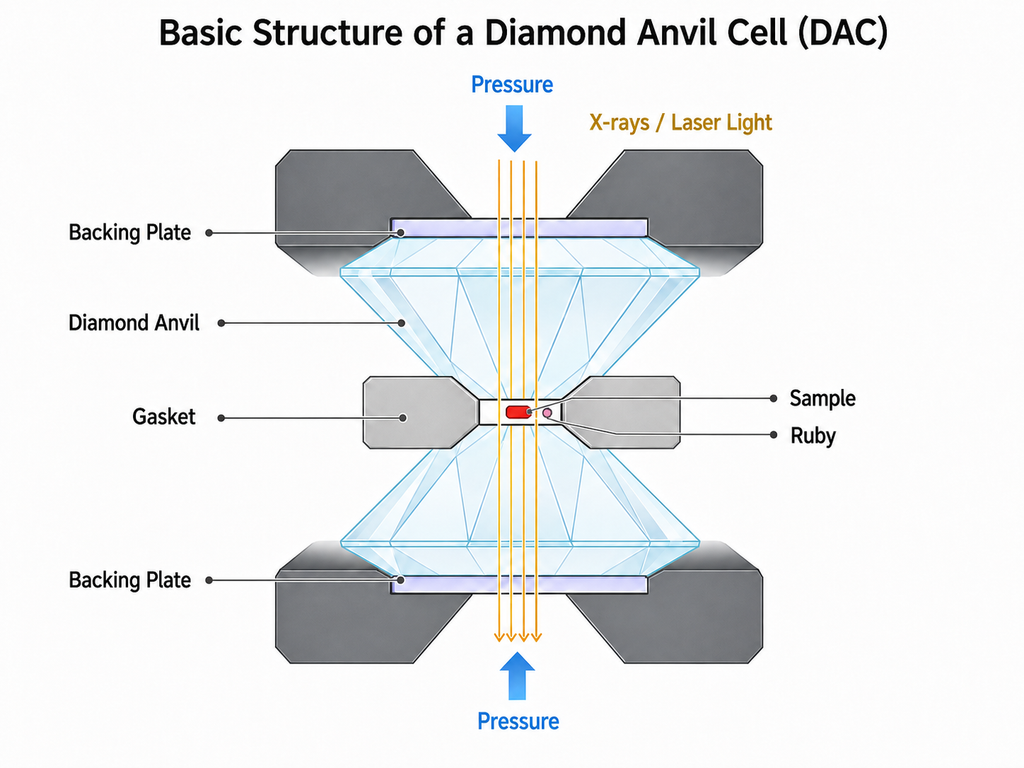
Although a DAC is compact, its structure incorporates several features designed to generate ultra-high pressure in a controlled manner.
Two Diamond Anvils Compress the Sample
The core of a DAC consists of two diamond anvils positioned opposite each other.
The flat culet surfaces face one another, with the sample positioned between them.
As force is applied through the cell body, the two diamond anvils move closer together and compress the sample at the center.
Pressure Is Concentrated at the Culet
The flat surface at the tip of the diamond anvil is called the culet.
In general, a smaller culet makes it possible to generate higher pressure with the same applied load.
However, reducing the culet diameter also reduces the available sample volume and increases stress on the diamond.
The appropriate culet size therefore depends on factors such as:
- target pressure
- sample size
- measurement method
- diamond quality
- anvil geometry
The Sample Is Placed Inside a Gasket Between the Diamond Anvils
In a typical DAC, a thin metal plate called a gasket is positioned between the two diamond anvils.
A microscopic hole is created in the center of the gasket and used as the sample chamber.
It may contain:
- the sample
- a pressure-transmitting medium
- a pressure calibration material
The sample is therefore not simply crushed directly between two bare diamonds.
Instead, the gasket forms a sample chamber that holds the material and pressure medium as the system is compressed.
Beveling Around the Culet Enables Even Higher Pressures
For experiments targeting especially high pressures, the area surrounding the culet may be machined into one or more inclined surfaces.
This is known as beveling.
Typical structures may include:
- culet
- 1st bevel
- 2nd bevel
Multi-stage geometries such as a double bevel or two-stage bevel can help control the stress distribution around the culet and enable experiments at even higher pressures.
Research using DACs equipped with beveled diamond anvils has reached pressure ranges approaching 400 GPa.
LUMERA INDUSTRIAL also supports custom diamond anvil machining based on specifications such as culet diameter, 1st bevel, and 2nd bevel.
One example includes:
- Culet: 100 µm
- 1st bevel: 300 µm
- 2nd bevel surface
What Are Diamond Anvil Cells Used For?

Diamond anvil cells allow researchers to investigate forms and properties of matter that cannot normally be observed under everyday conditions.
Major applications include the following.
Recreating Conditions Deep Inside the Earth
One of the most important applications of DACs is the study of Earth’s deep interior.
Pressure and temperature increase dramatically with depth inside the Earth.
Using a diamond anvil cell, researchers can generate pressures above 200 GPa and temperatures of several thousand kelvin to investigate materials under conditions comparable to the mantle and core.
Such experiments can help researchers understand:
- how minerals change crystal structure deep inside the Earth
- how materials such as iron behave under extreme conditions
- what types of chemical reactions occur inside the Earth
Discovering New Materials Under Ultra-High Pressure
Applying pressure changes the distances and arrangements between atoms.
As a result, a material may transform into a crystal structure that does not exist under normal atmospheric conditions, or it may begin to exhibit completely different physical properties.
Studying these pressure-induced phase transitions is another major application of diamond anvil cells.
DACs are widely used in materials science and condensed-matter physics to investigate fundamental material properties and search for new materials.
Studying Superconductivity
Diamond anvil cells also play an important role in superconductivity research.
Some hydrogen-rich materials have been reported to enter superconducting states when subjected to extremely high pressures.
DACs allow researchers to generate these conditions and investigate the resulting materials using techniques such as high-energy X-ray diffraction.
Materials and Physical Property Research
DACs can be used to measure how a material changes as pressure increases.
Researchers may investigate:
- crystal structure
- electrical resistance
- optical properties
- magnetic properties
- phase transitions
- chemical reactions
For this reason, diamond anvil cells are used across physics, chemistry, Earth science, materials science, and many other research fields.
Why Is Diamond Used in a Diamond Anvil Cell?
There are four major reasons why diamond is particularly well suited for DAC experiments.
It Can Withstand Extremely High Pressure
Diamond has exceptional mechanical properties and can concentrate large loads onto a very small culet surface.
It Is Optically Transparent
Diamond is highly transparent across a broad range of wavelengths, allowing researchers to observe samples through the anvil.
It Enables X-Ray Measurements
Combining a DAC with synchrotron X-rays makes it possible to analyze crystal structures while the sample remains under extreme pressure.
It Allows Laser Heating
Lasers can be directed through the diamond anvils to heat the sample while it is simultaneously compressed.
This technique, known as a laser-heated diamond anvil cell, makes it possible to reproduce both high-pressure and high-temperature conditions.
In this sense, the diamond anvil performs two roles at once: a compression tool and an observation window.
Natural vs. Lab-Grown Diamond: Which Is Used in a DAC?

Diamond anvils can be made from natural diamonds as well as artificially grown lab-grown diamonds.
Natural Diamonds Have Traditionally Been Used in DACs
Historically, natural single-crystal diamonds have been widely used for diamond anvils.
However, natural diamonds vary from crystal to crystal.
It may therefore be difficult to consistently obtain stones that meet specific requirements for:
- size
- purity
- internal strain
- crystal quality
Lab-Grown Diamonds Are Now Also Used for Diamond Anvils
Lab-grown diamonds are also used in high-pressure DAC research.
Although natural and lab-grown diamonds are produced through different processes, their fundamental chemical composition and crystal structure are the same.
Synthetic diamond anvils have previously been used in experiments generating pressures of 125 GPa and even above 200 GPa.
Synthetic Type IIa diamond anvils are also used in modern ultra-high-pressure research.
Therefore, being lab-grown does not mean a diamond cannot be used in a DAC.
What matters is whether the diamond meets the performance requirements of the specific experiment.
Gemological Quality Alone Does Not Determine DAC Performance
For research applications, important characteristics include:
- internal strain
- crystal defects
- crystallographic orientation
- diamond type and purity
- transparency
- fluorescence characteristics
- size
- culet machining accuracy
- bevel geometry
Gemological grades such as VVS can provide useful information about crystal quality, but a high-quality gemstone is not automatically the ideal diamond for every DAC experiment.
The diamond must be selected and machined according to the experimental requirements.
Lab-Grown Diamonds Can Reduce Diamond Anvil Procurement Costs
High-pressure experiments may require multiple diamond anvils, and researchers may also need spare anvils because of the possibility of breakage.
As a result, the unit price of each anvil can directly affect the research budget.
Depending on specifications, LUMERA INDUSTRIAL can provide lab-grown diamonds at approximately one-third to one-tenth the cost of comparable natural diamonds.
Lower procurement costs may allow researchers to obtain multiple anvils within the same budget or consider specifications that better match their experimental requirements.
Can Lab-Grown Diamond Anvils Actually Be Used in High-Pressure Experiments?

Industrial diamonds from LUMERA INDUSTRIAL
Researchers may reasonably ask whether lab-grown diamond anvils can perform reliably in actual high-pressure experiments.
LUMERA INDUSTRIAL has supplied lab-grown diamond anvils that have been used under real research conditions.
Under 80 GPa and Laser Heating Conditions
Diamond anvils supplied by LUMERA INDUSTRIAL have been used in experiments, one of the world’s major synchrotron radiation facilities.
They were successfully used under conditions of 80 GPa with laser heating.
A pressure of 80 GPa corresponds to approximately 790,000 atmospheres.
High-pressure experiments combining synchrotron X-rays and laser heating require more than simple resistance to pressure. Anvil geometry, optical characteristics, and machining precision can also be important.
Used in Experiments Above 30 GPa
LUMERA INDUSTRIAL diamond anvils with two-stage bevel processing have also been used in experiments exceeding 30 GPa.
One supplied configuration included:
- Culet: 100 µm
- 1st bevel: 300 µm
- 2nd bevel surface
These examples demonstrate that lab-grown diamonds can be used in high-pressure experiments when the required crystal quality and machining accuracy are achieved.
The important question is not simply whether the diamond is natural or lab-grown, but whether it satisfies the crystal and machining specifications required for the target pressure and measurement method.

How to Choose a Diamond Anvil
When selecting a diamond anvil for research, price and size alone are not enough.
The required specifications should be determined based on the experimental conditions.
Culet Diameter
The culet is the central surface where pressure is concentrated.
In general, smaller culets can generate higher pressures, but they also reduce the available sample volume and increase stress on the diamond.
The target pressure is therefore one of the most important factors when selecting culet size.
Bevel Geometry
For experiments targeting pressure ranges above 100 GPa, single-bevel or double-bevel geometries may be used.
Important parameters include:
- bevel diameter
- bevel angle
- number of bevel stages
Crystal Quality
Internal strain and crystal defects may increase the risk of diamond failure under high pressure.
For particularly demanding experiments, crystal selection should therefore be based on research requirements rather than appearance alone.
Crystallographic Orientation
The crystallographic orientation of the diamond can also be important depending on the experiment.
The appropriate orientation should be selected according to mechanical requirements, machining conditions, and the measurement method.
Diamond Type and Purity
Diamonds are classified into types such as:
- Type Ia
- Type Ib
- Type IIa
- Type IIb
The most suitable type depends on the measurement method.
For example, in infrared or Raman spectroscopy, absorption or fluorescence from the diamond itself may affect measurements, making purity and diamond type important considerations.
Target Pressure
An experiment designed for 30 GPa may require a very different diamond anvil specification from one targeting 100 GPa or more than 200 GPa.
Determining the maximum target pressure in advance makes it easier to select an appropriate culet diameter and bevel geometry.
Use of Laser Heating or X-Rays
For experiments involving:
- laser heating
- Raman spectroscopy
- infrared spectroscopy
- synchrotron X-ray diffraction
the diamond should be selected according to the wavelengths and measurement conditions involved.
A research-grade diamond anvil is therefore not simply “a diamond component.”
It should be treated as part of the experimental system and specified accordingly.
LUMERA INDUSTRIAL supports consultation on diamond specifications including crystallographic orientation, growth method, size, transparency, color, culet diameter, and bevel processing.
Frequently Asked Questions About Diamond Anvil Cells
- How Much Pressure Can a Diamond Anvil Cell Generate?
-
The achievable pressure depends strongly on factors such as:
- culet diameter
- diamond anvil geometry
- diamond quality
- DAC design
Experiments above 100 GPa are well established, and conventional DACs have reached pressure ranges of several hundred GPa.
Static pressures of approximately 410 GPa have also been reported.
- How Many GPa Is One Million Atmospheres?
-
One million atmospheres is approximately 101.3 GPa.
Because one standard atmosphere equals 101,325 Pa:
1,000,000 atm × 101,325 Pa
= 101,325,000,000 Pa
= 101.325 GPaTherefore, 100 GPa corresponds to approximately 987,000 atmospheres and is often described more simply as “about one million atmospheres.”
- Why Does the Diamond Not Break?
-
Diamond has exceptional hardness and mechanical properties, making it suitable for use as an anvil material under extreme pressure.
However, diamond can still break.
Potential causes include:
- internal defects
- crystal strain
- culet geometry
- uneven loading
- misalignment between the two anvils
For ultra-high-pressure experiments, diamond quality, machining precision, and alignment are therefore all important.
- Do Diamond Anvils Have to Be Made from Natural Diamond?
-
No.
Both natural diamonds and synthetic or lab-grown diamonds can be used as DAC anvils.
Synthetic diamond anvils have been used in research at pressures above 100 GPa and even 200 GPa.
- Can Lab-Grown Diamonds Be Used in a Diamond Anvil Cell?
-
Yes.
Whether natural or lab-grown, the key factors are the crystal quality, geometry, and machining precision required for the target pressure and measurement method.
LUMERA INDUSTRIAL lab-grown diamond anvils have been used in:
- 80 GPa laser-heated experiments at SPring-8
- experiments above 30 GPa at a national research institute
- How Much Does a Diamond Anvil Cost?
-
The price of a diamond anvil depends on specifications such as:
- diamond size
- crystal quality
- diamond type
- crystallographic orientation
- culet diameter
- bevel processing
- machining precision
- order quantity
There is therefore no single standard price.
Depending on specifications, LUMERA INDUSTRIAL can provide lab-grown diamonds at approximately one-third to one-tenth the cost of comparable natural diamonds.
For accurate pricing, a quotation based on the required experimental conditions and quantity is recommended.
Diamond Is More Than a Gemstone: It Is a Material Supporting Advanced Science
A diamond anvil cell is a compact experimental device capable of generating pressures approaching one million atmospheres by compressing a sample between two small diamond anvils.
The basic principle—concentrating force onto an extremely small area—is simple.
In practice, however, advanced high-pressure research depends on several unique properties of diamond, including:
- exceptional mechanical strength
- optical transparency
- compatibility with X-ray measurements
- precise culet and bevel machining
- high crystal quality
These characteristics make diamond anvil cells essential tools in fields ranging from Earth science and new-material discovery to superconductivity and condensed-matter research.
Today, researchers can choose not only natural diamonds but also high-quality lab-grown diamonds for research-grade diamond anvils.
LUMERA INDUSTRIAL supplies lab-grown diamonds for industrial and research applications and supports custom diamond anvil specifications including culet diameter, bevel geometry, crystallographic orientation, and size.
If you are looking to reduce the cost of natural diamond anvils, need anvils suitable for experiments around 100 GPa, or require custom culet and bevel geometries, we can propose specifications based on your experimental requirements.